Buteyko breathing exercises can be incredibly powerful.
But how you breathe during the rest of the day matters too. Everyday habits can cause us to breathe more air than we need.
This means breathing out too much carbon dioxide, which can increase nervous system activation and reduce blood flow and oxygen delivery.
I think of these as little breathing leaks. Here are some of the most common ones to look out for.
Talking (Too Much)
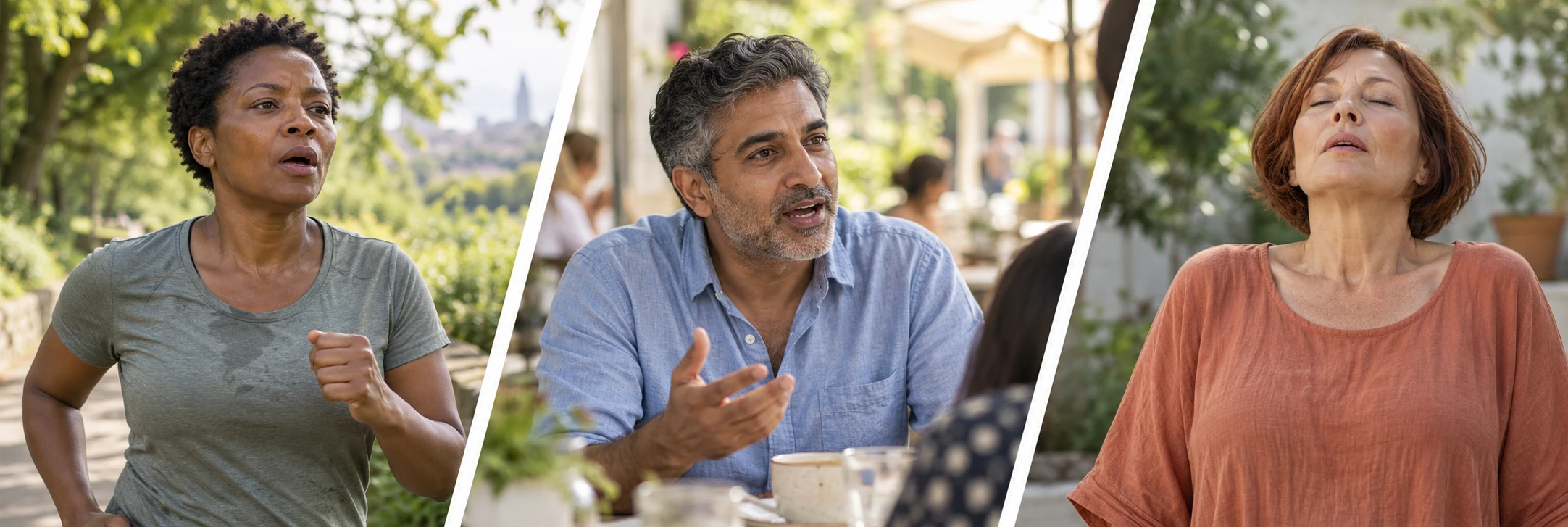
When we talk, we breathe more air.
The longer the sentence, the larger the breath we tend to take before the next one. We can also repeatedly take those little sharp breaths when we’re waiting for an opportunity to jump into a conversation.
Experiment with listening more than talking. People often really value being heard, so the person you’re with may appreciate it too.
When you do talk, slow things down and allow some pauses.
If you need to talk a lot for work, there are also more advanced Buteyko skills for breathing more efficiently while speaking, which I sometimes work on with one-to-one clients.
Physical exercise — when the intensity is too high
Physical exercise, done correctly, can be incredibly powerful for improving our breathing.
The problem is when the intensity is higher than your current breathing can comfortably handle.
Breathing more heavily during exercise is normal. But in some people, breathing can become excessive or remain unsettled after the workout.
The simplest thing you can do is:
Adjust the intensity so you can comfortably breathe through your nose, with only a mild to moderate air hunger.
Rushing
Think about what happens when you’re trying to get something finished, jumping straight from one task to another or squeezing more into an already full day.
Our nervous system becomes more activated and our breathing tends to speed up with it.
Slow the pace down.
Give yourself more time and more space between tasks.
You don’t even need to focus directly on your breathing. Slowing yourself down can calm the nervous system, with the breathing often following in the background.
Technology
I’ve connected myself and friends to a capnograph (a device that measures carbon dioxide in exhaled breath) while working.
It’s amazing how quickly breathing can change when someone starts answering emails or gets absorbed in their phone.
Breathing can become noticeably faster and shallower without us realising it.
Take regular technology breaks and occasionally notice what your breathing is doing.
Sometimes simply putting the phone down or stepping away from the screen is enough to change it.
For practical tips on spending less time on your phone: https://www.humanetech.com/take-control.
For reminders to take breaks during long or intensive laptop work, install BreakTimer: https://breaktimer.app/.
Habitual sighing, yawning and recovery breaths
Sighs and yawns can happen naturally as our nervous system shifts state. Yawning is also common before sleep and stretches the muscles around the upper airway.
Here, I mean the habitual pattern: sighing from frustration, or repeated yawns, sighs and “recovery breaths” to relieve lingering air hunger — the feeling that you can’t quite get a satisfying breath.
When you recognise that habitual pattern, see if you can gently resist the urge to follow it. It’s a bit like trying not to scratch an itch.
There’s no need to suppress a natural sigh or yawn. Afterwards, let your breathing return to quiet nasal breathing.
Deep-breathing mistakes
Surprisingly, people can also over-breathe while doing a breathing exercise.
A lot of online techniques involve taking very large or deep breaths. That doesn’t necessarily mean the technique is wrong — but it’s important to understand the whole method.
Be particularly aware if repeated deep breathing leaves you lightheaded or dizzy, or if your hands or feet start to tingle or go numb. These can be signs that you’re breathing out too much carbon dioxide. If this happens, stop the exercise and let your breathing return to normal.
When it comes to calming the nervous system, bigger breathing is not always better.
ONE CHANGE IS A START
Start plugging the leaks
Notice which of these patterns applies to you and start there.
You don’t need to monitor or control your breathing all day — that can become stressful in itself. The aim is simply to become more aware of the situations where you tend to over-breathe and make small adjustments.
And if you’re still regularly breathing through your mouth, comfortable nasal breathing is the first thing I’d work on.
TAKE THE NEXT STEP
The Breathing Reset
If you’re really interested in transforming the way you breathe, The Breathing Reset takes this much further — teaching you how breathing works, the lifestyle changes that matter, and the breathing exercises I use to help make breathing slower, lighter and more diaphragmatic while supporting a calmer nervous system.
Explore The Breathing ResetWith Neil Tranter · Learn at your own pace
 READ NEXTA 24-Hour Nervous System Reset